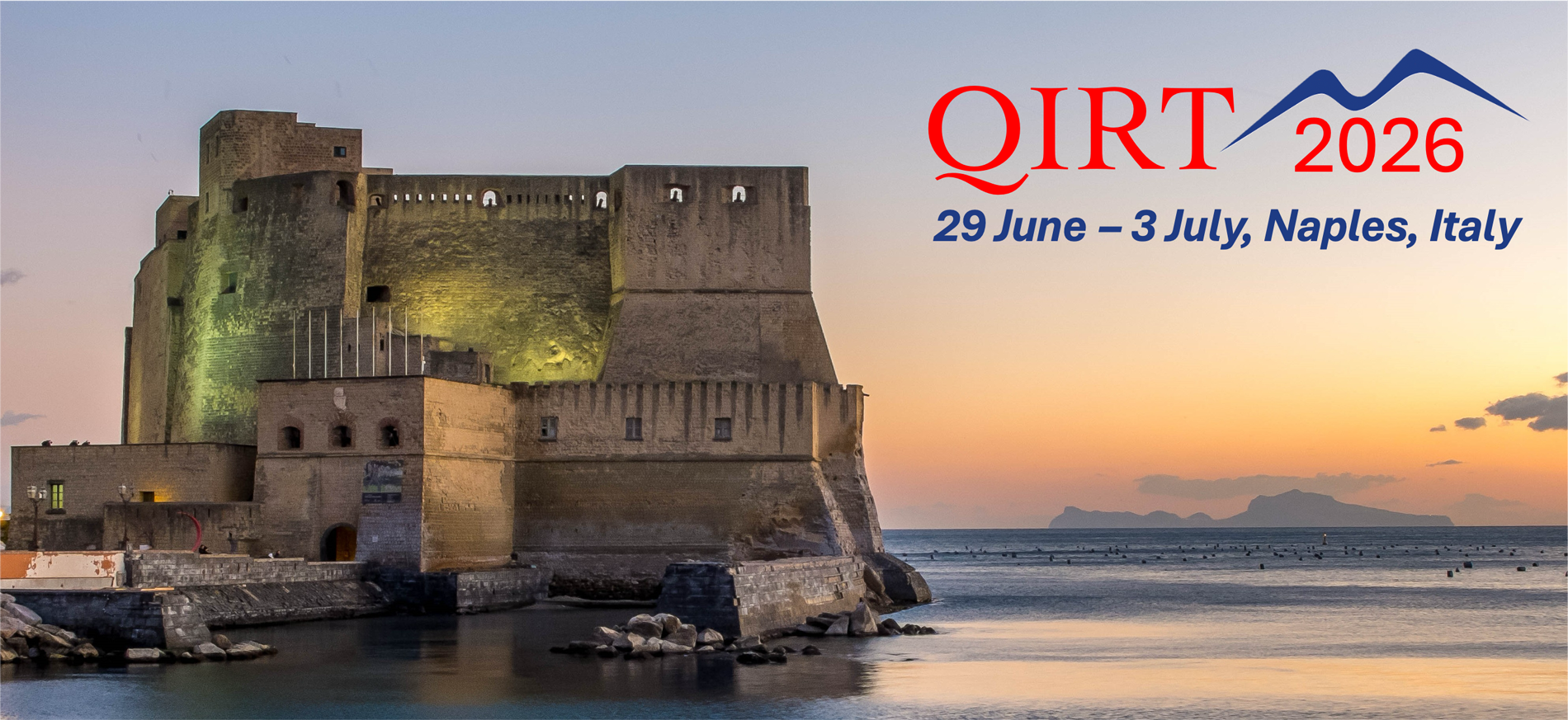
29 June 2026 to 3 July 2026
University of Naples Federico II Conference Center
Europe/Rome timezone

QIRT Short Courses

The Quantitative InfraRed Thermography short courses are designed for engineers, scientists, and students who have basic knowledge of the field and have recently started—or plan to start—using Infrared Thermography for industrial or scientific applications. The tuition fee is €200

Courses program

Monday, June 29, 2026

  • 08:00 – 09:00: Registration Desk
  • 09:00 – 10:00: Basic IR Thermography – Prof. Xavier Maldague
  • 10:20 – 11:20: IR Thermography in NDT: From Fundamentals to Automation – Prof. Nicolas P. Avdelidis
  • 11:40 – 12:40: Infrared thermography for cultural heritage inspection and evaluation – Prof. Stefano Sfarra
  • 12:40 – 14:10: Lunch Break
  • 14:10 – 15:20: Biomedical Applications of Infrared Thermography – Prof. Gunther Steenackers
  • 15:40 – 16:40: Thermal Problems in Fluid Dynamics – Prof. Carlo S. Greco


Prof. Xavier MALDAGUE
Laval University
Canada  

Xavier Maldague is a professor at the Department of Electrical and Computing Engineering of the Laval University in Québec (QC), Canada. He has trained more than 50 graduate students (MSc and PhD) and has more than 300 publications. His research interests are in infrared thermography, non-destructive evaluation (NDE) techniques and vision/digital systems for industrial inspection. He holds a Tier 1 Canada Research Chair in Infrared Vision. He is also a chairs of the Quantitative Infrared Thermography (QIRT) Council and a fellow of the Canada Engineering Institute, a Honorary Fellow of the Indian Society of NondestructiveTesting and a fellow of the Alexander von Humbolt Foundation in Germany. 

Basic IR Thermography

The presentation will deal with the following topics: introduction, theory (radiometry and heat transfer considerations), modelling for 1D, 2D, 3D geometry in solids materials, thermal stimulations in the active approach, infrared detectors and experimental techniques, deployment, data processing and applications. It is expected this short course will enable the attendees to grasp the fundamentals of IR thermography for non-destructive testing. 


Prof. Nicolas P. AVDELIDIS
University of Southampton
United Kingdom 

Professor Avdelidis (Nico) is a Professor of Aerospace Systems Management in the Department of Aeronautics & Astronautics, School of Engineering at the University of Southampton in the UK. He is also an Adjunct Professor at Universite Laval (Quebec, Canada), within the Department of Electrical and Computer Engineering and the Computer Vision and Systems Laboratory, where he does a lot of his research activities there in collaboration also with other organizations in Canada. Nico has worked both in various academic and industrial environments, managing a growing and vibrant research portfolio. He has successfully developed and delivered various courses on topics such as Autonomous Systems Inspection of Aerospace Structures, Predictive Maintenance Technology, Unmanned Aircraft Systems, as well as served as the Programme Director and/or course Director of MSc courses in the areas of Aviation, Aerospace, and Transport. Nico has contributed extensively to several research areas, such as non-destructive testing and evaluation (NDT&E) of materials and structures, robotic and autonomous systems in aircraft MRO, advanced IR and other non-invasive imaging techniques, and health management of aircraft systems and structures. 


IR Thermography in NDT: from Fundamentals to Automation

IR Thermography (IRT) is a non-contact technique that could be applied efficiently for the inspection and/or monitoring of large-area components. It is expected that this short course will enable the attendees to grasp the fundamentals of IR thermography for non-destructive testing (i.e. different modes, configurations, sources, etc) and at the same time go through practical case studies (numerical and experimental) to realize the significance of the technique in NDT. Furthermore, the advantages and limitations of IRT for fully automated and/or autonomous assessments in large areas - structures would also be discussed. Finally, the role of advanced image post processing techniques such as Principal Component Thermography (PCT), Thermal Signal Reconstruction (TSR), etc, in enhancing the accuracy of defect detection in NDT would also be discussed.


Prof. Stefano SFARRA
University of L’Aquila
Italy  

Professor Stefano Sfarra attained a Ph.D. title in mechanical, management and energy engineering at the University of L’Aquila (UNIVAQ), Italy, in 2011. Following the achievement of the Ph.D., he was a research fellow at UNIVAQ until 2017, before becoming a researcher in October of the same year. 
He carried out research and teaching periods abroad at prestigious institutions all over the world. He was also an invited-scientific researcher at Tomsk Polytechnic University (Tomsk, Russia), as well as a member of several scientific committees at international conferences.
He is also an editor of Infrastructures (MDPI), and Sensors (MDPI). Since December 2020, he is the editor-in-chief (EiC) of the Quantitative InfraRed Thermography (QIRT) Journal (Taylor & Francis). He is deeply involved in the non-destructive evaluation and characterization of materials, especially using optical and infrared vision non-destructive testing techniques, numerical simulations centered on heat transfer phenomena (by Comsol© Multiphysics), development of ad hoc scripts in Matlab©environment, and inverse thermal modelling.
In these research areas, Prof. Sfarra authored or co-authored more than 300 papers in Journals and International Conferences. He also have written seven chapters in Books. He is currently acting as a reviewer of around 50 scientific journals; he is principal investigator, collaborator and local contact person in international research projects.
He is also a member of Associazione MASTER, Associazione Italiana della Fisica Tecnica and Associazione Italiana Proprietà Termofisiche.
He received many awards, mainly focused on scientific recognition.
In October 2020, he became associate professor at UNIVAQ. He has been an adjunct professor at Laval University (Canada).


Infrared thermography for cultural heritage inspection and evaluation

During this short course, a review on the use of ‘infrared vision’ (and in particular of IRT) for the inspection of cul¬tural heritage objects is provided. In particular, a series of experiences done by the speaker together with esteemed colleagues is discussed, the contribution of mock-ups is stressed, and the main current activities of the bilat¬eral Italy-China research project for “science and technology cooperation” (Italian unit: University of L’Aquila, P.I. Prof. S. Sfarra; Chinese unit: Harbin Institute of Technology, P.I. Prof. H. Zhang), titled “sCHans – Solar loading infrared thermog-raphy and deep learning teCHniques for the noninvAsive iNSpection of precious artifacts” (promoted by the Italian Ministry of Foreign Affairs and International Cooperation and co-financed by the Ministry of University and Research, grant number PGR02110) is illustrated. 


Prof. Gunther STEENACKERS
University of Antwerp
Belgium 

Gunther Steenackers is a head of Department of Electromechanics of the University of Antwerp and full professor at InViLab Research Group.


Biomedical Applications of Infrared Thermography

During this short course, an introduction will be given to how infrared thermography can contribute to the identification of (changing) biomedical and biomechanical parameters. Biomedical applications that will be discussed are the identification of skin cancer, the use of thermal cameras in breast reconstructions and blood vessel detection as well as a few biomechanical applications and comfort assessment.


Prof. Carlo S. GRECO
University of Naples Federico II
Italy 

Carlo Salvatore Greco is an Associate Professor of Fluid Dynamics at the Department of Industrial Engineering, Università di Napoli "Federico II". He earned his Master's degree in Aerospace Engineering in 2011 and was awarded a Ph.D. in 2015. In 2016, he joined the University of Naples as a staff researcher. His research focuses on Flow Control, Heat Transfer, and Aerodynamics, utilizing both experimental techniques and numerical simulations. His work is documented in over 30 publications, many of which have appeared in leading international journals such as Aerospace Science and Technology, AIAA Journal, Journal of Fluid Mechanics, and International Journal of Heat and Mass Transfer. He has collaborated with several international research teams within funded programs and is currently leading two scientific projects funded by the Italian Ministry of Research. Since 2013, he has been a member of the International Centre for Heat and Mass Transfer Scientific Committee and the Scientific Advisory Board of the Quantitative InfraRed Thermography Journal.


Thermal Problems in Fluid Dynamics

This short course reviews the evolution of infrared (IR) thermography into a powerful optical diagnostic for complex fluid flows, with an emphasis on measuring surface convective heat fluxes and investigating surface flow-field behavior. The course analyzes steady and unsteady heated thin foil and thin film sensors in various applications, including thermal management with cooling jets, laminar-to-turbulent boundary-layer transition studies, and boundary-layer behavior on propellers. Hands-on examples and case studies will demonstrate how to integrate IR thermography with heat-flux sensors to produce spatially and temporally resolved convective heat-flux maps. The course is aimed at researchers and engineers seeking advanced thermal diagnostics for fluid-flow research.